 Travel
Jul 5, 2026
How to get an Indian medical visa: step by step
Documents you need, how long it takes, and how to bring a companion with you.
6 min readRead guide

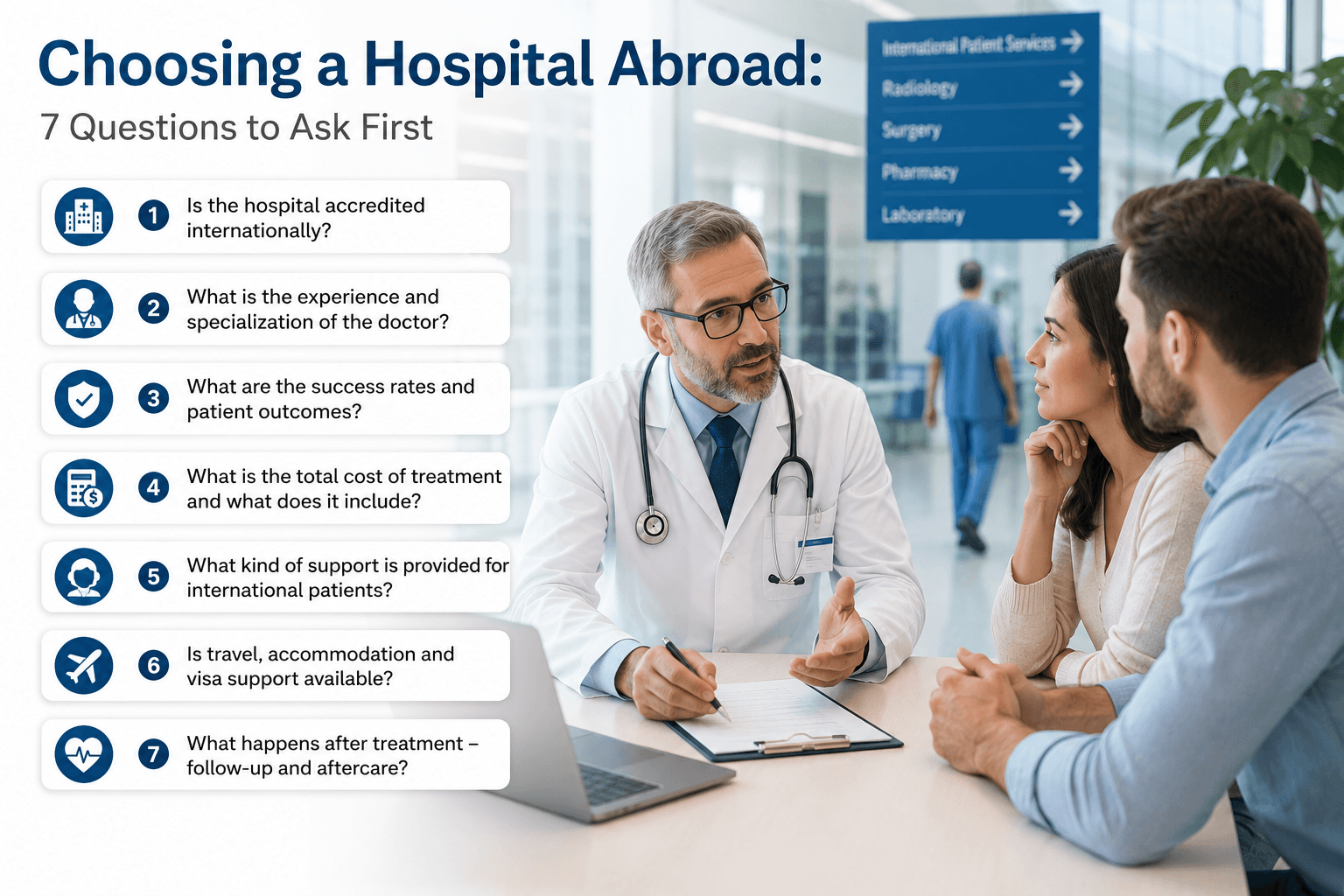
As a surgeon, I am asked one question more than any other by international patients: 'How do I know a hospital is good?' It is the right question — and there are seven better versions of it that will tell you almost everything you need to know before you commit to treatment anywhere in the world.
JCI and NABH publish searchable directories of every accredited hospital. Thirty seconds on their websites verifies a claim that a brochure can fake. Check the accreditation is current — hospitals do lapse — and that it covers the specific facility you will be treated at, not just the group's flagship.
In high-volume Indian centres, a senior joint-replacement surgeon may perform 800 knees a year; research consistently links surgical volume to better outcomes. Ask for the name of the operating surgeon (not the department), their years in practice, and their annual volume of your specific procedure. A confident hospital answers in writing.
Then ask to speak to them. A ten-minute video consultation tells you more about how you will be treated than any website.
Ask for the unit's success and complication rates for your procedure, and how they compare to international benchmarks. Ask what the hospital's surgical-site infection rate is — accredited hospitals track this obsessively. And ask who responds if something worries you at 2 a.m.: a good international-patient programme has a named person, not a switchboard.
None of these questions is rude. Hospitals that welcome scrutiny tend to be the ones that withstand it.
Great hospitals quote a fixed package for a defined procedure, with exclusions listed in writing. Vague ranges and 'estimates subject to final billing' are how surprise invoices happen. This is also where a facilitator earns its keep: we hold partner hospitals to written fixed pricing, so the quote you approve is the amount you pay.
Take these seven questions to any hospital in the world — including ours. The answers will sort your shortlist faster than any ranking website.
Send your reports and get a specialist's opinion with an exact quote — free, within 48 hours.